
Philodendrons are in all probability my favourite group of houseplants. Not simply because there are such a lot of varieties to select from, or as a result of they’re all comparatively straightforward to take care of. It’s often because after you have one, you’ll be able to develop tens or tons of extra, with little or no effort.
When you’ve by no means propagated a houseplant earlier than, a philodendron is among the finest locations to begin. They’re extremely straightforward to propagate from cuttings, regardless of which sort you’ve got. So long as the plant you’re beginning with is wholesome and huge sufficient, even newcomers received’t wrestle to propagate philodendron.
The strategy under works throughout the big selection of philodendron varieties, from trailing varieties to upright growers. The anatomy varies barely between species, however the underlying precept is identical. Roots develop from nodes, so so long as your slicing consists of one, you’ve got what you want.
Begin with a Wholesome Plant

A slicing can solely be as wholesome because the plant it got here from. Beginning with a robust, actively rising mum or dad plant provides your slicing one of the best likelihood of rooting rapidly and establishing properly.
To propagate philodendron, search for stems with agency, vibrant foliage and no indicators of illness, pest injury, or stress. Keep away from taking cuttings from yellowing stems, sections with mushy or discolored tissue, or crops which were fighting overwatering or root rot. A slicing taken from a compromised plant carries these issues with it and is much much less prone to root efficiently.
It’s finest to propagate in the course of the lively rising season in spring or summer time. Cuttings taken throughout this era root sooner and set up extra vigorously than these taken in fall or winter. The mum or dad plant additionally recovers extra rapidly from the pruning when it’s actively rising.
Determine the Nodes

Nodes are crucial a part of philodendron propagation. With no node, your slicing received’t produce roots, regardless of how lengthy it sits in water.
A node is the purpose on a stem the place leaves, aerial roots, or branches emerge. On most philodendrons, nodes seem as barely thickened or raised sections alongside the stem, usually with a visual bump or ring. Aerial roots (if current) develop immediately from nodes, which makes them straightforward to identify.
Each slicing you are taking wants a minimum of one node, ideally two. The node is the place the brand new root system will develop, so it’s the non-negotiable aspect. A slicing with an exquisite leaf however no node is only a leaf in water. It could keep inexperienced for some time, nevertheless it received’t develop into a brand new plant.
Take a Chopping

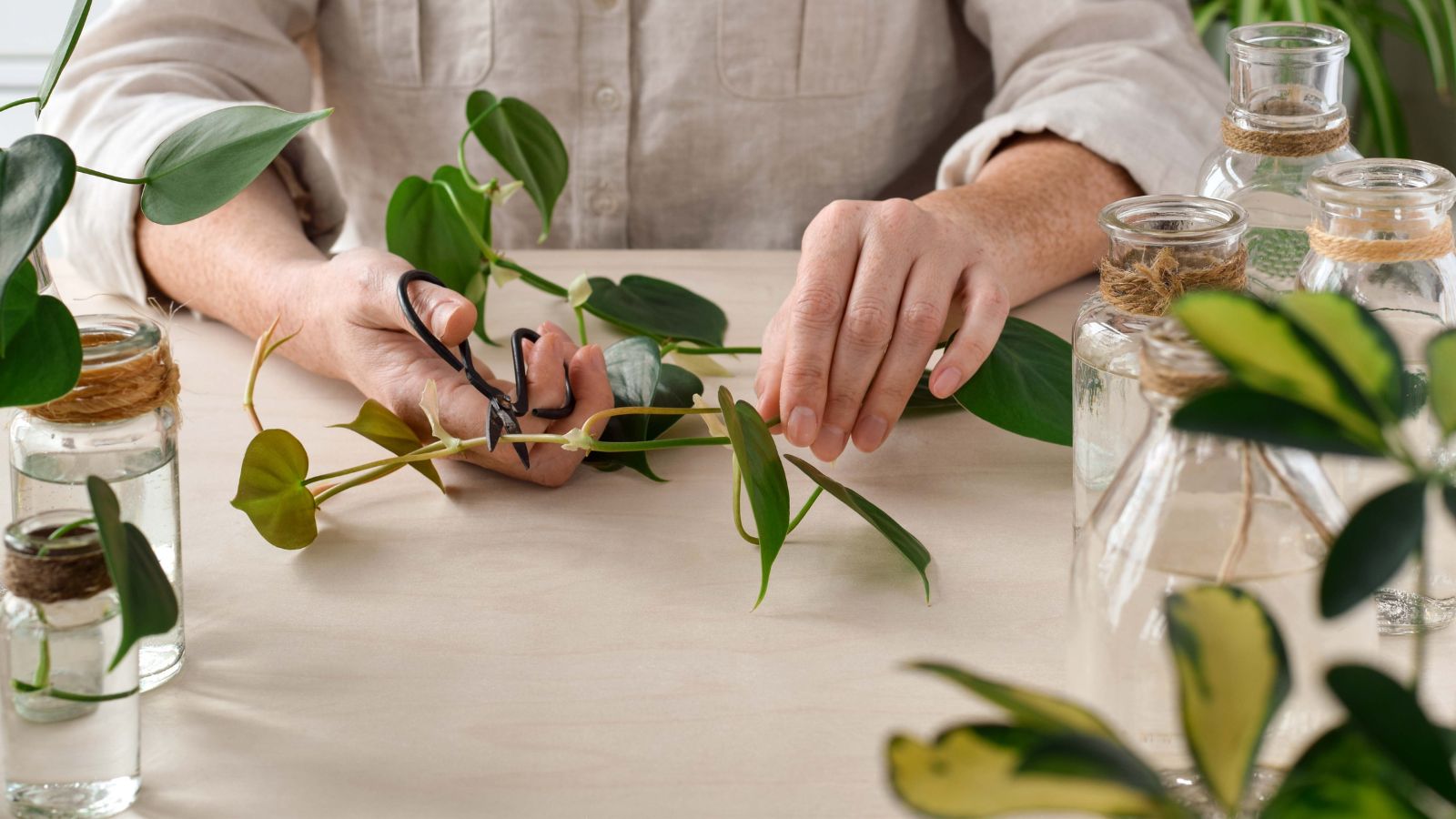
When you’ve recognized your nodes, use a clear, sharp blade to take the slicing. A grimy or uninteresting blade can crush the stem tissue and introduce micro organism that trigger rot earlier than the slicing has an opportunity to root. It’s finest to wipe your scissors or knife with rubbing alcohol earlier than you begin.
Minimize the stem about half an inch under a node, making a clear, straight minimize. Every slicing ought to embody one or two nodes and a minimum of one or two wholesome leaves. Leaves present the vitality the slicing wants to supply roots via photosynthesis, so don’t take away all of them.
How lengthy the slicing needs to be is determined by the expansion behavior of your specific philodendron. On some species, a slicing with a few nodes may be only a few inches lengthy. On others, chances are you’ll find yourself with an extended part. The size issues lower than ensuring you’ve got nodes, wholesome leaves, and a clear minimize.
You’ll be able to take a number of cuttings from a single stem if it’s lengthy sufficient, so long as every part has a minimum of one node. The mum or dad plant will produce new development from the remaining nodes on the stem, so don’t fear about slicing it again. Generally, pruning truly encourages the plant to department and fill out.
Take away Backside Leaves

Any leaves that will sit under the waterline throughout rooting should be eliminated. Submerged leaves rot rapidly, clouding the water and creating situations that encourage bacterial development across the slicing.
Gently take away the bottom leaves by peeling them again from the stem or slicing them near the bottom. Go away the higher leaves intact to maintain the slicing photosynthesizing. A slicing with one or two leaves above the waterline is right to propagate philodendron. In case your slicing has lots of foliage, eradicating an additional leaf or two reduces the quantity of moisture the slicing loses via transpiration whereas it’s making an attempt to root.
Root in Water
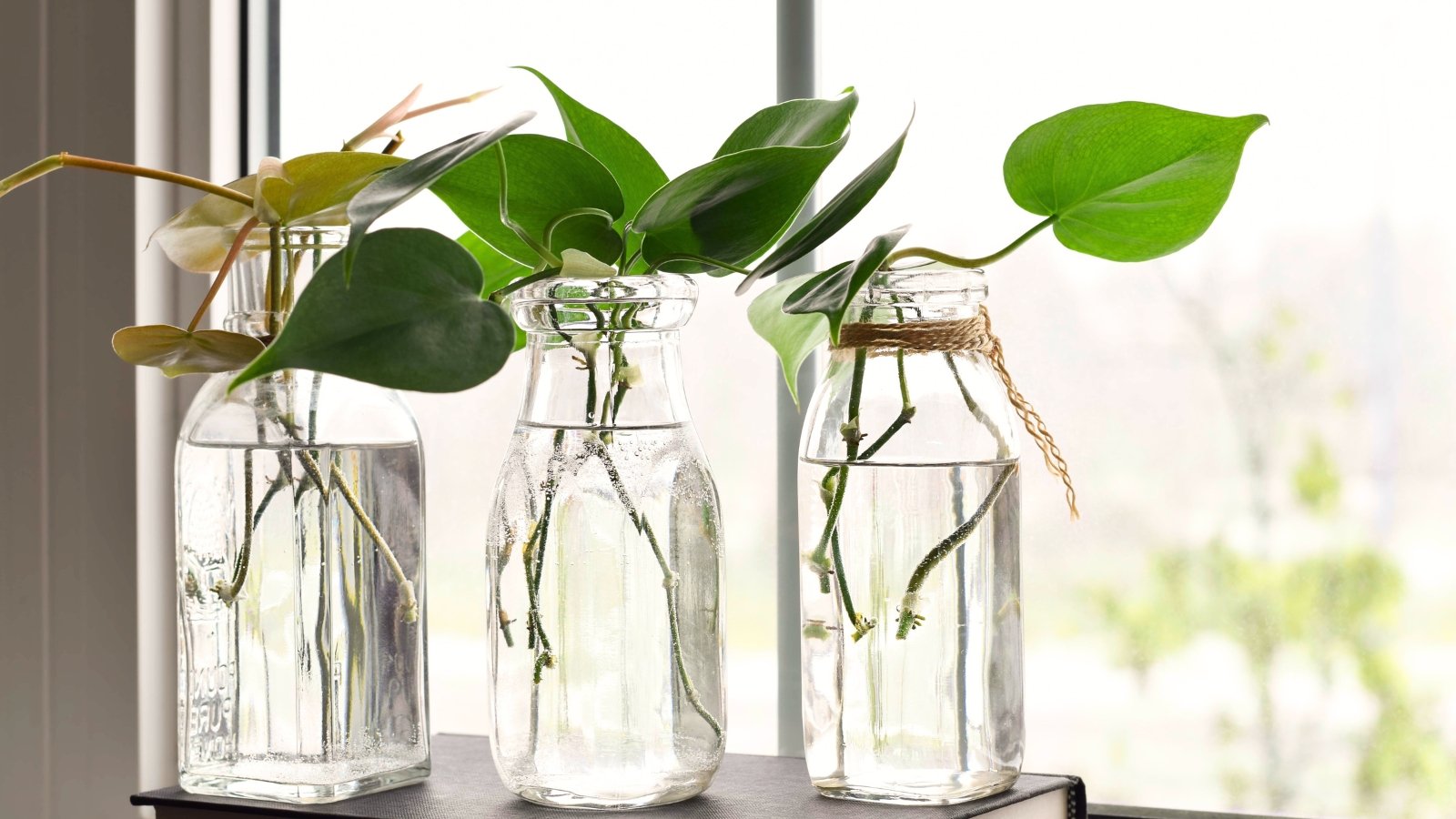
Place the slicing in a clear glass or jar crammed with room-temperature water, ensuring a minimum of one node is submerged. The leaves ought to stay above the waterline. A transparent container permits you to monitor root growth with out disturbing the slicing.
Set the jar in a spot with brilliant, oblique gentle. Keep away from direct daylight, which might encourage algae development. Heat, secure temperatures between 65°F and 80°F promote the quickest root growth.
Change the water each few days, or each time it begins to look cloudy. Recent water gives oxygen to the growing roots and prevents bacterial buildup that may trigger the slicing to rot. When you discover any sliminess on the stem or a foul odor, rinse the slicing underneath working water, trim away any comfortable tissue, and place it in a recent jar.
Roots usually start to seem inside one to a few weeks, relying on the species, the time of 12 months, and the situations. You’ll see small white or light-colored roots rising from the node. Allow them to develop to a minimum of one to 2 inches lengthy earlier than transplanting. Longer roots set up extra simply in soil, so there’s no rush to maneuver the slicing as quickly as the primary root seems.
Transplant
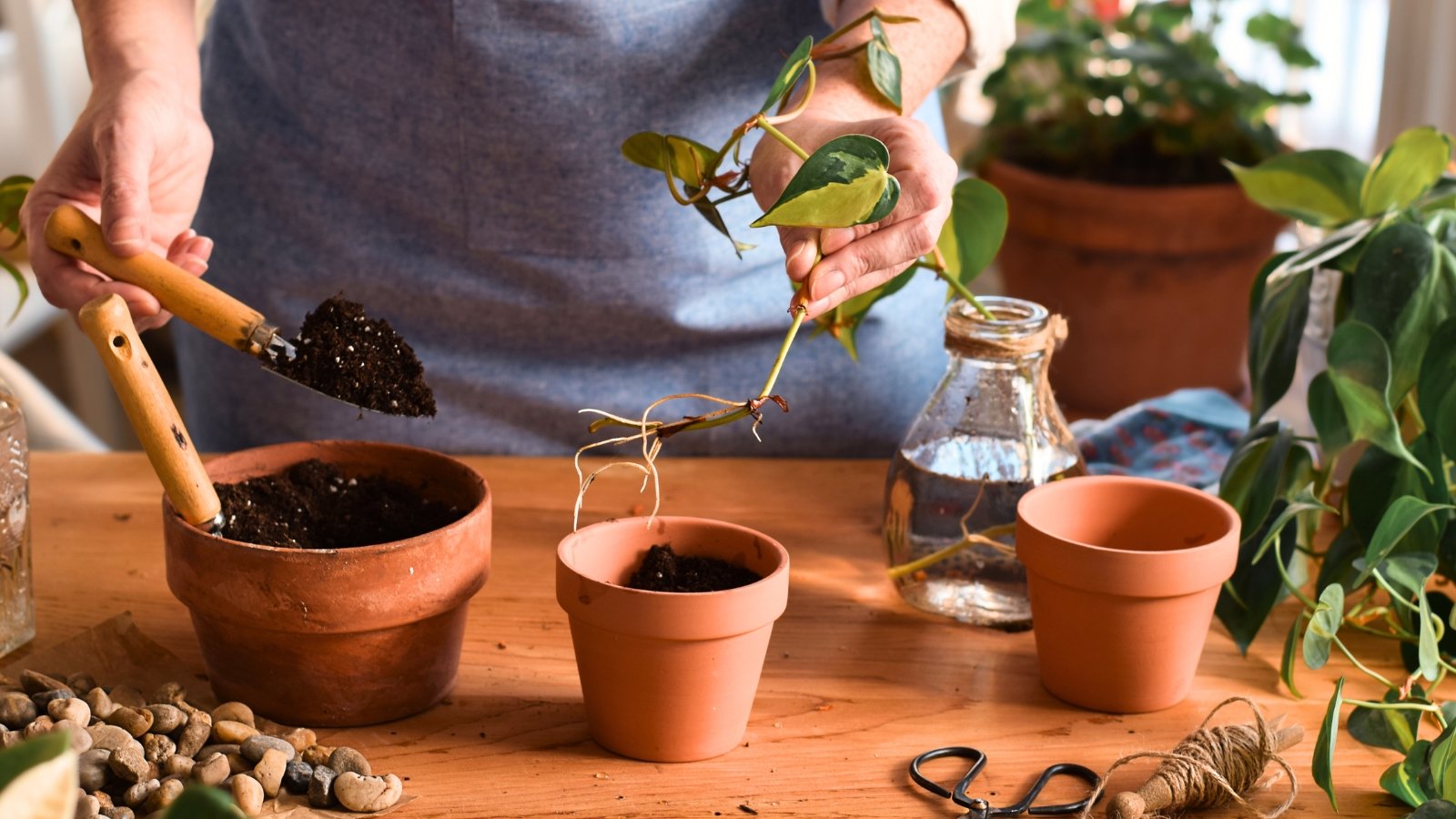
As soon as the water roots are a few inches lengthy, the slicing is able to transfer into soil. Don’t wait too lengthy, although. Roots that develop in water are structurally completely different from soil roots, and the longer they develop in water, the extra adjustment the plant wants when it transitions to soil.
Select a small pot with drainage holes. Fill the pot with a well-draining aroid potting combine, or a mix of ordinary potting soil with added perlite for additional drainage. Make a gap within the middle, gently place the slicing so the roots are coated and the bottom node is under the soil floor, and agency the soil calmly across the base. Water totally and let the surplus drain.
For the primary few weeks after transplanting, hold the soil moist however not soggy. The slicing must transition from absorbing water immediately via its roots to pulling moisture from soil, and constant moisture helps it make that shift with out stress. When you see new leaf development, the foundation system has established and you may start watering as you’ll a mature plant.
Place the newly potted slicing in brilliant, oblique gentle and keep away from shifting it round in the course of the first few weeks. Stability helps the plant settle in. With the precise situations, new development often seems inside a month or so after you propagate philodendron, and from there, you’ll have a totally unbiased plant to maintain or share.
🔥 Trending Offers You Might Like
Searching for nice offers? Discover our newest discounted merchandise:




One Comment