The start
Just a few months in the past, whereas engaged on the Databricks with R workshop, I got here
throughout a few of their customized SQL capabilities. These explicit capabilities are
prefixed with “ai_”, they usually run NLP with a easy SQL name:
> SELECT ai_analyze_sentiment('I'm joyful');
  constructive

> SELECT ai_analyze_sentiment('I'm unhappy');
  unfavourable
This was a revelation to me. It showcased a brand new approach to make use of
LLMs in our every day work as analysts. To-date, I had primarily employed LLMs
for code completion and growth duties. Nonetheless, this new method
focuses on utilizing LLMs instantly towards our information as a substitute.
My first response was to try to entry the customized capabilities by way of R. With
dbplyr we are able to entry SQL capabilities
in R, and it was nice to see them work:
orders |>
  mutate(
    sentiment = ai_analyze_sentiment(o_comment)
  )
#> # Supply:   SQL [6 x 2]
#>   o_comment                   sentiment
#>
#> 1 ", pending theodolites …    impartial
#> 2 "uriously particular foxes …   impartial
#> 3 "sleep. courts after the …  impartial
#> 4 "ess foxes could sleep …      impartial
#> 5 "ts wake blithely uncommon … combined
#> 6 "hins sleep. fluffily …     impartial
One draw back of this integration is that though accessible via R, we
require a stay connection to Databricks with a purpose to make the most of an LLM on this
method, thereby limiting the quantity of people that can profit from it.
In response to their documentation, Databricks is leveraging the Llama 3.1 70B
mannequin. Whereas this can be a extremely efficient Giant Language Mannequin, its huge dimension
poses a big problem for many customers’ machines, making it impractical
to run on commonplace {hardware}.
Reaching viability
LLM growth has been accelerating at a fast tempo. Initially, solely on-line
Giant Language Fashions (LLMs) had been viable for every day use. This sparked considerations amongst
corporations hesitant to share their information externally. Furthermore, the price of utilizing
LLMs on-line may be substantial, per-token fees can add up rapidly.
The best answer can be to combine an LLM into our personal techniques, requiring
three important elements:
- A mannequin that may match comfortably in reminiscence
- A mannequin that achieves enough accuracy for NLP duties
- An intuitive interface between the mannequin and the consumer’s laptop computer
Prior to now 12 months, having all three of those parts was almost not possible.
Fashions able to becoming in-memory had been both inaccurate or excessively sluggish.
Nonetheless, current developments, corresponding to Llama from Meta
and cross-platform interplay engines like Ollama, have
made it possible to deploy these fashions, providing a promising answer for
corporations seeking to combine LLMs into their workflows.
The undertaking
This undertaking began as an exploration, pushed by my curiosity in leveraging a
“general-purpose” LLM to supply outcomes corresponding to these from Databricks AI
capabilities. The first problem was figuring out how a lot setup and preparation
can be required for such a mannequin to ship dependable and constant outcomes.
With out entry to a design doc or open-source code, I relied solely on the
LLM’s output as a testing floor. This offered a number of obstacles, together with
the quite a few choices obtainable for fine-tuning the mannequin. Even inside immediate
engineering, the chances are huge. To make sure the mannequin was not too
specialised or centered on a particular topic or end result, I wanted to strike a
delicate steadiness between accuracy and generality.
Luckily, after conducting in depth testing, I found {that a} easy
“one-shot” immediate yielded the perfect outcomes. By “finest,” I imply that the solutions
had been each correct for a given row and constant throughout a number of rows.
Consistency was essential, because it meant offering solutions that had been one of many
specified choices (constructive, unfavourable, or impartial), with none extra
explanations.
The next is an instance of a immediate that labored reliably towards
Llama 3.2:
>>> You're a useful sentiment engine. Return solely one of many
... following solutions: constructive, unfavourable, impartial. No capitalization.
... No explanations. The reply is predicated on the next textual content:
... I'm joyful
constructive
As a facet word, my makes an attempt to submit a number of rows directly proved unsuccessful.
In truth, I spent a big period of time exploring totally different approaches,
corresponding to submitting 10 or 2 rows concurrently, formatting them in JSON or
CSV codecs. The outcomes had been usually inconsistent, and it didn’t appear to speed up
the method sufficient to be definitely worth the effort.
As soon as I turned comfy with the method, the subsequent step was wrapping the
performance inside an R package deal.
The method
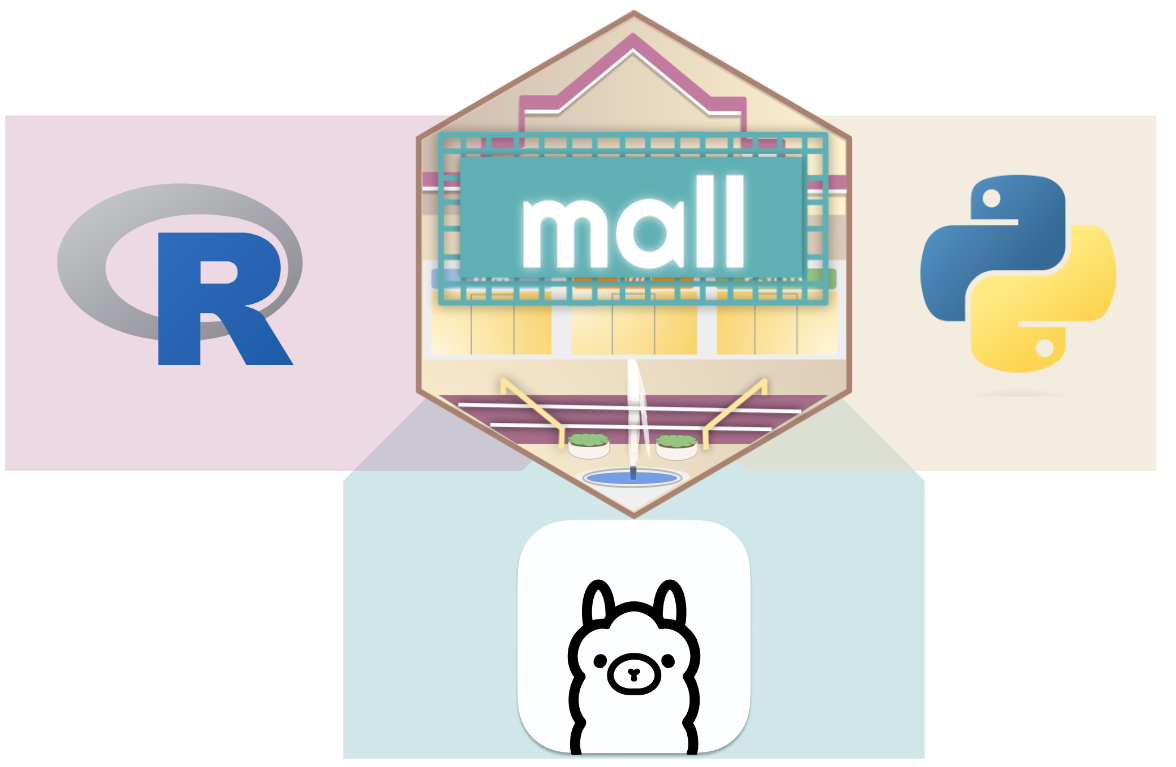
One in every of my targets was to make the mall package deal as “ergonomic” as attainable. In
different phrases, I wished to make sure that utilizing the package deal in R and Python
integrates seamlessly with how information analysts use their most well-liked language on a
every day foundation.
For R, this was comparatively simple. I merely wanted to confirm that the
capabilities labored nicely with pipes (%>% and |>) and might be simply
included into packages like these within the tidyverse:
evaluations |>
  llm_sentiment(evaluate) |>
  filter(.sentiment == "constructive") |>
  choose(evaluate)
#>                                                               evaluate
#> 1 This has been the perfect TV I've ever used. Nice display screen, and sound.
Nonetheless, for Python, being a non-native language for me, meant that I needed to adapt my
fascinated about information manipulation. Particularly, I discovered that in Python,
objects (like pandas DataFrames) “comprise” transformation capabilities by design.
This perception led me to analyze if the Pandas API permits for extensions,
and luckily, it did! After exploring the chances, I made a decision to start out
with Polar, which allowed me to increase its API by creating a brand new namespace.
This easy addition enabled customers to simply entry the mandatory capabilities:
>>> import polars as pl
>>> import mall
>>> df = pl.DataFrame(dict(x = ["I am happy", "I am sad"]))
>>> df.llm.sentiment("x")
form: (2, 2)
┌────────────┬───────────┐
│ x          ┆ sentiment │
│ ---        ┆ ---       │
│ str        ┆ str       │
╞════════════╪═══════════╡
│ I'm joyful ┆ constructive  │
│ I'm unhappy   ┆ unfavourable  │
└────────────┴───────────┘
By retaining all the brand new capabilities throughout the llm namespace, it turns into very straightforward
for customers to search out and make the most of those they want:

What’s subsequent
I believe will probably be simpler to know what’s to come back for mall as soon as the group
makes use of it and offers suggestions. I anticipate that including extra LLM again ends will
be the principle request. The opposite attainable enhancement will probably be when new up to date
fashions can be found, then the prompts could have to be up to date for that given
mannequin. I skilled this going from LLama 3.1 to Llama 3.2. There was a necessity
to tweak one of many prompts. The package deal is structured in a approach the longer term
tweaks like that will probably be additions to the package deal, and never replacements to the
prompts, in order to retains backwards compatibility.
That is the primary time I write an article in regards to the historical past and construction of a
undertaking. This explicit effort was so distinctive due to the R + Python, and the
LLM features of it, that I figured it’s value sharing.
If you happen to want to study extra about mall, be happy to go to its official website:
Supply hyperlink
🔥 Trending Offers You Might Like
Searching for nice offers? Discover our newest discounted merchandise: