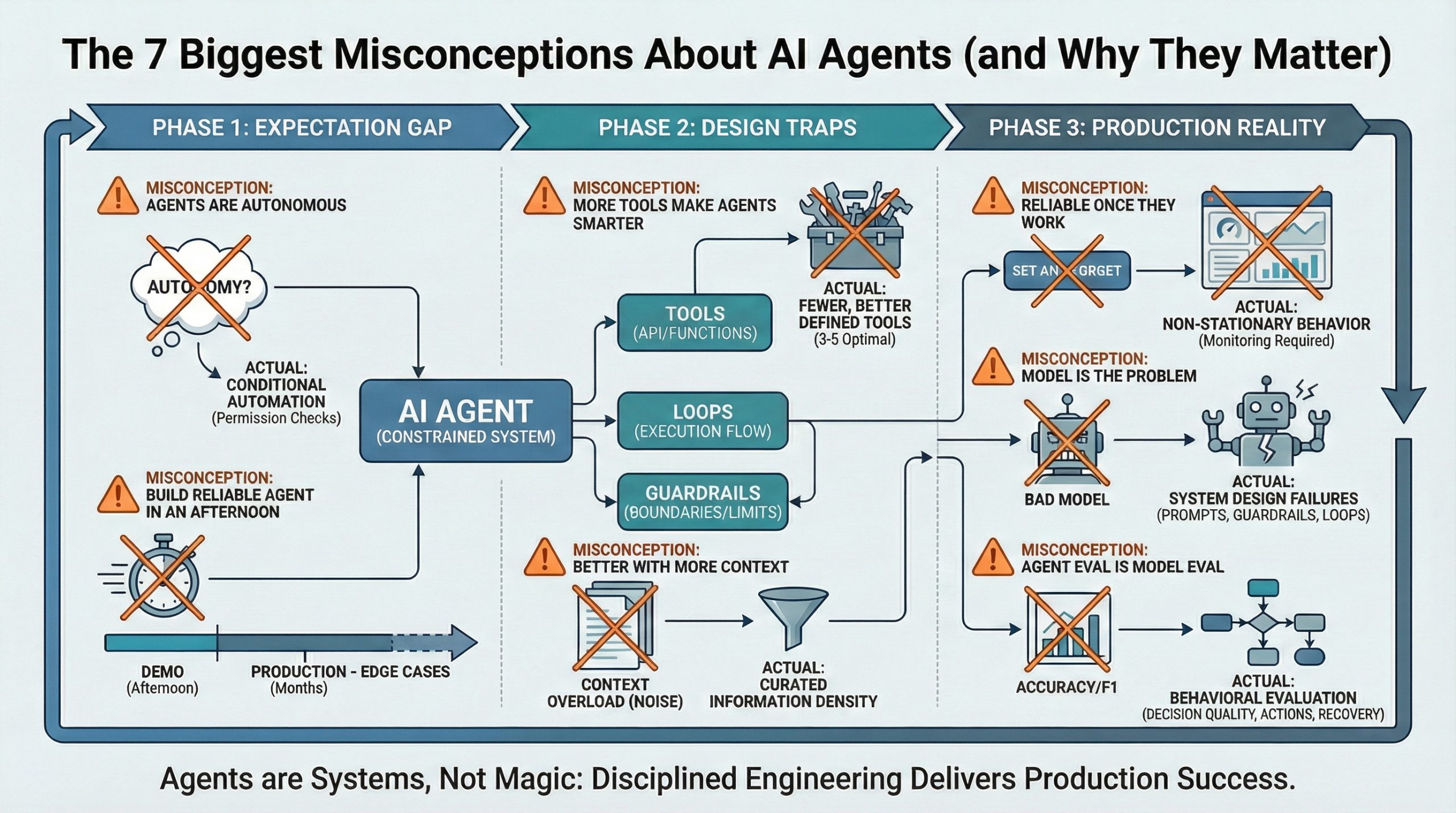
The 7 Largest Misconceptions About AI Brokers (and Why They Matter) (click on to enlarge)
Picture by Writer
AI brokers are in all places. From buyer help chatbots to code assistants, the promise is straightforward: techniques that may act in your behalf, making choices and taking actions with out fixed supervision.
However most of what individuals consider about brokers is unsuitable. These misconceptions aren’t simply tutorial. They trigger manufacturing failures, blown budgets, and damaged belief. The hole between demo efficiency and manufacturing actuality is the place tasks fail.
Listed below are the seven misconceptions that matter most, grouped by the place they seem within the agent lifecycle: preliminary expectations, design choices, and manufacturing operations.
[=”” products=”v1|389593247509|0″ visible=”description” title_tag=”div” img_ratio=”4×3″ =”2,1″] [=”” products=”FXAUTOBOTS” visible=”description” title_tag=”div” img_ratio=”4×3″ =”2,1″]Section 1: The Expectation Hole
False impression #1: “AI Brokers Are Autonomous”
Actuality: Brokers are conditional automation, not autonomy. They don’t set their very own objectives. They act inside boundaries you outline: particular instruments, rigorously crafted prompts, and specific stopping guidelines. What appears to be like like “autonomy” is a loop with permission checks. The agent can take a number of steps, however solely alongside paths you’ve pre-approved.
Why this issues: Overestimating autonomy results in unsafe deployments. Groups skip guardrails as a result of they assume the agent “is aware of” to not do harmful issues. It doesn’t. Autonomy requires intent. Brokers have execution patterns.
False impression #2: “You Can Construct a Dependable Agent in an Afternoon”
Actuality: You possibly can prototype an agent in a day. Manufacturing takes months. The distinction is edge-case dealing with. Demos work in managed environments with happy-path eventualities. Manufacturing brokers face malformed inputs, API timeouts, sudden software outputs, and context that shifts mid-execution. Every edge case wants specific dealing with: retry logic, fallback paths, sleek degradation.
Why this issues: This hole breaks mission timelines and budgets. Groups demo a working agent, get approval, then spend three months firefighting manufacturing points they didn’t see coming. The exhausting half isn’t making it work as soon as. It’s making it not break.
Section 2: The Design Traps
False impression #3: “Including Extra Instruments Makes an Agent Smarter”
Actuality: Extra instruments make brokers worse. Every new software dilutes the chance the agent selects the precise one. Device overload will increase confusion. Brokers begin calling the unsuitable software for a process, passing malformed parameters, or skipping instruments solely as a result of the choice area is simply too massive. Manufacturing brokers work finest with 3-5 instruments, not 20.
Why this issues: Agent failures are tool-selection failures, not reasoning failures. When your agent hallucinates or produces nonsense, it’s as a result of it selected the unsuitable software or mis-ordered its actions. The repair isn’t a greater mannequin. It’s fewer, better-defined instruments.
False impression #4: “Brokers Get Higher With Extra Context”
Actuality: Context overload degrades efficiency. Stuffing the immediate with paperwork, dialog historical past, and background data doesn’t make the agent smarter. It buries the sign in noise. Retrieval accuracy drops. The agent begins pulling irrelevant data or lacking important particulars as a result of it’s looking via an excessive amount of content material. Token limits additionally drive up price and latency.
Why this issues: Data density beats data quantity. A well-curated 2,000-token context outperforms a bloated 20,000-token dump. In case your agent’s making unhealthy choices, examine whether or not it’s drowning in context earlier than you assume it’s a reasoning drawback.
Section 3: The Manufacturing Actuality
False impression #5: “AI Brokers Are Dependable As soon as They Work”
Actuality: Agent conduct is non-stationary. The identical inputs don’t assure the identical outputs. APIs change, software availability fluctuates, and even minor immediate modifications could cause behavioral drift. A mannequin replace can shift how the agent interprets directions. An agent that labored completely final week can degrade this week.
Why this issues: Reliability issues don’t present up in demos. They present up in manufacturing, below load, throughout time. You possibly can’t “set and overlook” an agent. You want monitoring, logging, and regression testing on the precise behaviors that matter, not simply outputs.
False impression #6: “If an Agent Fails, the Mannequin Is the Downside”
Actuality: Failures are system design failures, not mannequin failures. The standard culprits? Poor prompts that don’t specify edge circumstances. Lacking guardrails that permit the agent spiral. Weak termination standards that enable infinite loops. Dangerous software interfaces that return ambiguous outputs. Blaming the mannequin is simple. Fixing your orchestration layer is tough.
Why this issues: When groups default to “the mannequin isn’t adequate,” they waste time ready for the following mannequin launch as a substitute of fixing the precise failure level. Agent issues could be solved with higher prompts, clearer software contracts, and tighter execution boundaries.
False impression #7: “Agent Analysis Is Simply Mannequin Analysis”
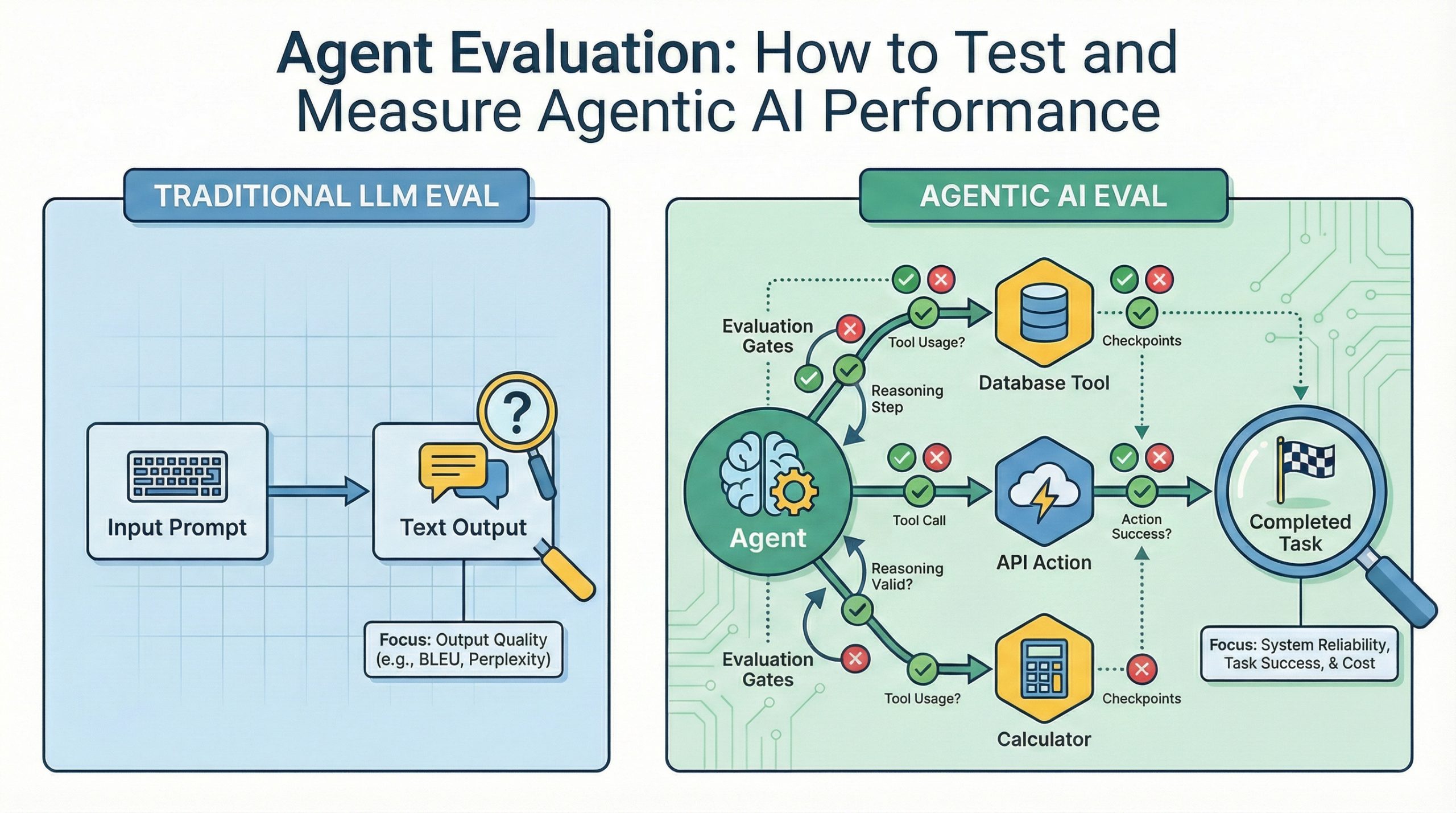
Actuality: Brokers have to be evaluated on conduct, not outputs. Traditional machine studying metrics like accuracy or F1 scores don’t seize what issues. Did the agent select the precise motion? Did it cease when it ought to have? Did it get better gracefully from errors? It’s worthwhile to measure determination high quality, not textual content high quality. Meaning monitoring tool-selection accuracy, loop termination charges, and failure restoration paths.
Why this issues: You possibly can have a high-quality language mannequin produce horrible agent conduct. In case your analysis doesn’t measure actions, you’ll miss a very powerful failure modes: brokers that decision the unsuitable APIs, waste tokens on irrelevant loops, or fail with out elevating errors.
Brokers Are Methods, Not Magic
Probably the most profitable agent deployments deal with brokers as techniques, not intelligence. They succeed as a result of they impose constraints, not as a result of they belief the mannequin to “determine it out.” Autonomy is a design selection. Reliability is a monitoring follow. Failure is a system property, not a mannequin flaw.
[=”” products=”v1|389096675189|0″ visible=”description” title_tag=”div” img_ratio=”4×3″]In the event you’re constructing brokers, begin with skepticism. Assume they’ll fail in methods you haven’t imagined. Design for containment first, functionality second. The hype guarantees autonomous intelligence. The fact requires disciplined engineering.
[=”” products=”FXLIFE” visible=”description” title_tag=”div” img_ratio=”4×3″]
About Vinod Chugani
Vinod Chugani is an AI and information science educator who has authored two complete e-books for Machine Studying Mastery: The Newbie’s Information to Information Science and Subsequent-Stage Information Science. His articles deal with information science fundamentals, machine studying functions, reinforcement studying, AI agent frameworks, and rising AI applied sciences, making complicated ideas actionable for practitioners at each stage.
By means of his instructing and mentoring work, Vinod focuses on breaking down superior ML algorithms, AI implementation methods, and rising frameworks into clear, sensible studying paths. He brings analytical rigor from quantitative finance and entrepreneurial expertise to his instructional strategy. Raised throughout a number of nations, Vinod creates accessible content material that makes superior AI ideas clear for learners worldwide.
Join with Vinod on LinkedIn.
Supply hyperlink